Note: advanced cycle course content has been reviewed and re-packaged - see here for details of current course offerings.
Industry Training Courses - Advanced Cycling
ViaStrada runs a series of training courses to introduce the principles of planning and design for cycling in New Zealand. The courses are aimed at anybody planning, designing or reviewing roads or other facilities that will be used by cyclists. The target audience is described in more detail below.
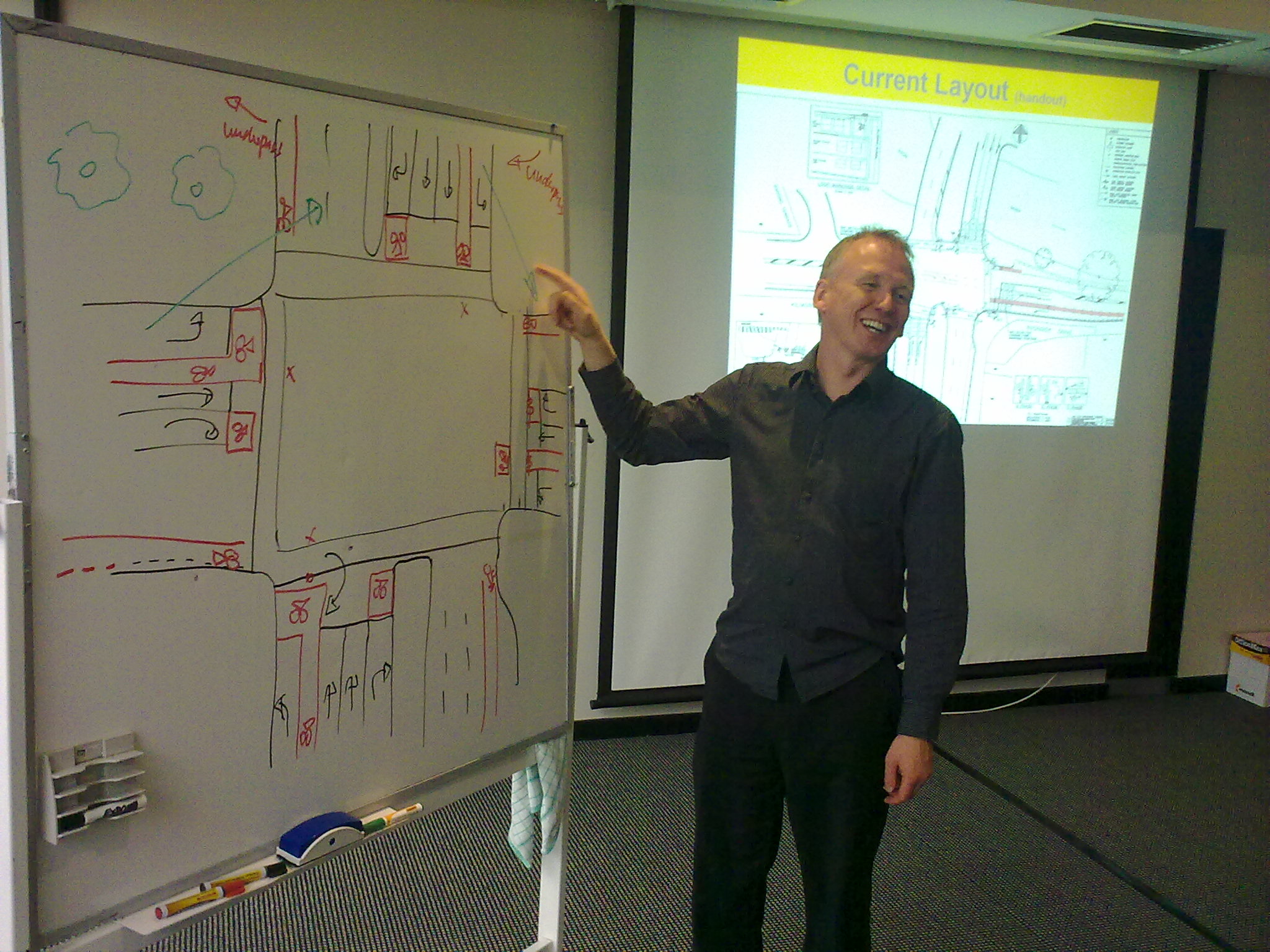
Following on from an award winning Fundamentals course, an Advanced course was developed in conjunction with the NZ Transport Agency (NZTA) to meet the needs of the NZ transportation industry. Attendee numbers are usually limited to 25 to ensure that there are opportunities for questions and discussion throughout the course. Lectures are complemented with hands-on exercises, and Module 4 comprises a site visit.
Generally, two instructors deliver each course, giving course participants a wide range of knowledge and experience, and a variety of presentation styles to keep things interesting. Instructors for 2014 are ViaStrada directors Axel Wilke and Warren Lloyd.
Tim Hughes (Senior Engineer, NZTA) says about the Fundamentals course: "When I travel around New Zealand, I can see the basic skills taught in this training course being applied to an increasing number of projects". The Advanced course modules now intend to lift the industry's performance to the next level of professional competence.
Some other testimonials include:
"Very useful course information which was presented in a very clear and helpful manner. Site visit was particularly useful. Thanks!"
"The course provides some great ideas or solutions to issues that have come up in previous design work and great references for further reading."
2014 Courses
ViaStrada ran series of courses over four days in February 2014, covering the Fundamentals of Planning and Design of Walking, Fundamentals of Planning and Design for Cycling and Advanced Cycling. These courses were in conjunction with Auckland Transport and were sold out.
Please contact Helen if you would like to register interest in future advanced courses.
Please note courses are also offered in:
Target Audiences
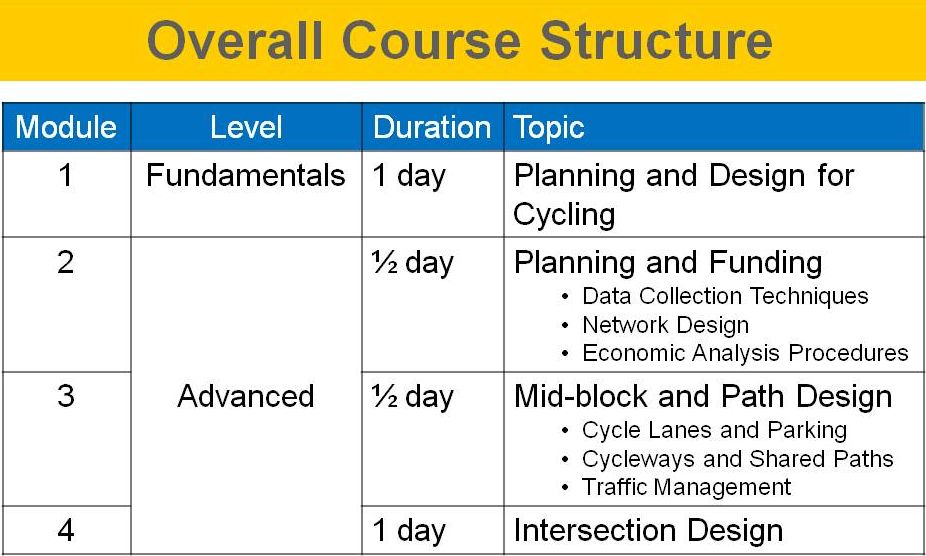
The Advanced course follows on from the Fundamentals course in three specialised modules relating to planning and funding, mid-block design and intersection design. While there are no prerequisites for attendance on the advanced modules, and each is aimed at a different target audience, delegates will find it beneficial to have completed the Fundamentals course (Module 1) or to have a similar level of understanding. If you are unsure, please contact us.
The target audiences for the four modules are as follows:
Module 1 - Fundamentals of Planning and Design for Cycling
The Fundamentals course covers a wide range of aspects related to planning and designing for cycling. It is aimed at anybody planning, designing or reviewing roads or other facilities that will be used by cyclists. This includes planners, road and traffic engineers and managers, road safety practitioners, decision makers and cycling advocates.
Module 2 - Advanced Planning and Funding
This module is primarily targeted at those involved in the higher level, strategic aspects of cycle provision. It will suit general city planners who are interested in providing for cyclists through city and district plan items and traffic planners and cycle planners who are interested in developing cycle networks based on existing data and subsequent demand predictions. Module 2 also covers funding mechanisms and thus will be of use to anyone involved in budgeting or seeking funding assistance for cycle related projects such as managers and decision makers.
At a secondary level, Module 2 will also be of some interest to traffic engineers who would like to gain a greater appreciation of the context of their designs with respect to wider network, strategic and financial implications and cycling advocates who wish to understand the mechanisms with which cycling projects are planned and funded. Given that Module 2 is run over one morning and then followed by Module 3 the same afternoon and Module 4 will often be held the following day, it may well be beneficial for those attending Modules 3 and 4 to also attend Module 2.
Module 3 - Mid-block Design
This module is primarily targeted at traffic engineers involved with designing facilities; as every traffic engineering project should include consideration of cyclists, this includes all traffic engineers, not just those who design cycle facilities. They will also be beneficial for road safety practitioners, especially those involved in cycling projects.
Module 3 will also be of use to cycling advocates to give them a greater appreciation of the technical aspects involved in designing facilities. There is a reasonable amount of technical content that may go beyond the interest or understanding of those not working in the industry. Although not specifically targeted at planners, managers and decision makers, Module 3 will be useful to those involved in higher level planning for cycling by helping them understand the considerations faced by designers.
Module 4 - Intersection Design
Like Module 3, this module is primarily targeted at traffic engineers involved with designing facilities and road safety practitioners.
Module 4 will also be of use to cycling advocates to give them a greater appreciation of the technical aspects involved in designing facilities. There is a reasonable amount of technical content that may go beyond the interest or understanding of those not working in the industry. Although not specifically targeted at planners, managers and decision makers, Module 4 will be useful to those involved in higher level planning for cycling by helping them understand the considerations faced by designers.